
Introduction
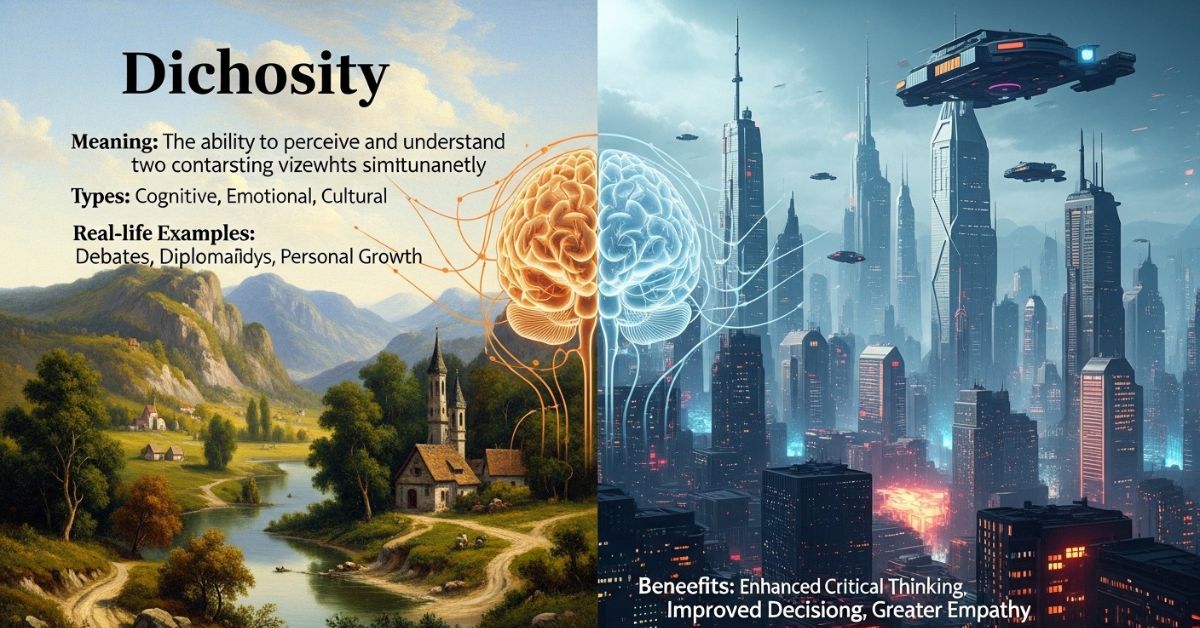
Dichosity is an intriguing yet frequently overlooked notion. The ability to maintain a dual viewpoint at the same time is what this term alludes to. The ability to adapt our thinking to new situations and problems is a key component of effective problem-solving. Envision yourself dealing with life’s obstacles not with a black-and-white mentality but with one that welcomes and celebrates complexity.
Its significance has grown in the modern, fast-paced world. Being able to consider opposing viewpoints is more important than ever in our climate of constantly shifting beliefs. Develop this quality, and you’ll be more equipped to understand and connect with others in any setting, whether it’s a workplace discussion, a social media debate, or just your own internal struggles for meaning.
The scientific basis of dichosity, its varieties, and its prevalence in our daily lives can be better understood if we take the time to investigate them. You can discover methods to use this great instrument for personal growth and improved communication by recognising its significance across numerous fields.
The Science behind Dichosity
Dichosity arises from the intriguing interaction of duality. It’s an idea that stresses the possibility of seemingly incompatible parts existing in one structure.
The intricacy of human cognition and experience is reflected in its essence. Theoretically, our brains are hardwired to spot patterns, and we tend to classify things into black-and-white categories. Embracing both views can lead to greater insights.
When it comes to species adaptation, biology presents a Dichosity. Different organisms may display different characteristics in order to adapt to different habitats. These alterations boost evolutionary success by making us more resilient.
Also, dichotic hearing is a real thing in psychology; it’s when both ears process separate stimuli at the same time. The ability of our thoughts to process competing signals while keeping focus on what’s truly important is on display here.
The more we learn about its scientific foundations, the more we can appreciate its function in many different areas and parts of life, and the more layers we may see that we might have missed before.
Types of Dichosity
Dichosity takes many forms, and each one sheds light on the mind and behaviour in its own special way.
When people sense two or more opposing emotions at the same time, it’s known as emotional dichosity. Major life events, for instance, might evoke a range of emotions.
To be cognitively dichotomous is to simultaneously hold two ideas that are diametrically opposed. This causes cognitive dissonance, which manifests as an internal conflict as one tries to reconcile these seemingly incompatible thoughts.
Our relationship-navigation styles are mirrored by social Dichosity. Because of our shared history, we may love someone deeply while harbouring bitter feelings of anger towards them.
Ethical ideals are shown to be at odds with one another in moral dichosity. Conflicting values can put people in a difficult position, requiring them to reflect deeply on their own principles and the choices they’ve made in the past.
Our comprehension of the complexities of human experience is enhanced by each form of Dichosity.
Examples of Dichosity in Daily Life
Unbeknownst to us, Dichosity permeates every aspect of our daily lives. Think about multitasking for a moment. Trying to find happiness while simultaneously tending to your professional and personal obligations is a perfect example of Dichosity.
Think about what you eat. Consider a salad topped with avocado or crispy bacon for an example of a healthy yet decadent lunch. The duality of our eating habits is illustrated by this combination, which offers both nutritious value and rich flavour.
Even in partnerships, there are two sides. In addition to providing emotional support, friends can push us to our limits by revealing our weaknesses or highlighting our divergent viewpoints. The depth of our relationships is enhanced with every interaction.
Contrasting themes, such as happiness and sadness in a single painting, can evoke complex emotions all at once, and art is a prime illustration of this. All around, these examples show how Dichosity influences our views and choices.
Uses of Dichosity in Different Fields
Incorporating Dichosity into different domains improves comprehension and inspiration. Psychologists can use it to better understand the complexities of human behaviour. With this knowledge, we can develop treatment methods that work better.
Dichosity is a tool that writers use to build nuanced characters in literature. Narratives are more interesting and engaging on several levels when contrasting features interact with one another.
It helps businesses make better decisions. In order to find solutions that are fair to all parties involved, leaders may have to consider competing tactics or principles.
User experience design can be enhanced even in the technological realm by quantifying dichosity. Developers create interfaces that are appealing to a wide audience while also satisfying individual needs by thinking about competing user preferences.
This complex idea encourages innovation by embracing complexity instead of avoiding it, and it opens doors across disciplines.
How to Cultivate and Enhance
Begin by welcoming competing viewpoints if you want to foster and amplify Dichosity. Push yourself to think at things from many angles. The mind is opened and comprehension is deepened through this activity.
Take part in pursuits that encourage analysis and evaluation. Many different ways of thinking can be sparked by puzzles, arguments, or even creative writing. Your understanding of intricacy will deepen as you delve further into it.
Put yourself in the company of others who have different opinions than your own. In order to find better answers to problems, it’s important to have interactions with people from different backgrounds.
To help you see things from many angles, consider keeping a notebook. Keep track of instances when different perspectives meet or compliment one another; this practice will help you become more attuned to the dichotomies in your environment.
Embrace the paradoxes that life presents. To better understand the complexities of reality, it is important to constantly challenge assumptions and look for the grey spaces where black-and-white thinking coexist.
Conclusion
Dichosity is an intriguing idea that permeates many parts of our existence. Gaining an understanding of its significance and practical uses might be advantageous for one’s career and personal development. The study of dichosity sheds light on the ways in which seemingly incompatible ideas can coexist, which in turn inspires fresh approaches to old problems.
Dichosity in all its forms reveals the nuanced nature of human feelings and relationships. Recognising these duality aids us in navigating life’s many facets, from relationships to decision-making. Examples from real life show how dichosity appears in commonplace contexts, serving as a reminder that contradictions are common in human life.
The acceptance of duality has the potential to inspire innovation and perseverance in many domains, including the arts, education, psychology, and business. Developing this quality calls for introspection and work, but the payoff in flexibility is high.
Delving into it reveals fresh viewpoints on the obstacles we encounter on a daily basis. Recognising the harmony between seemingly incompatible aspects of ourselves and those around us might help us see opportunities for development that would otherwise go unnoticed. We gain a deeper knowledge of ourselves and the people around us when we embrace this duality.
You May Like : Business RobTheCoins: Unlock Crypto Success in 2026