


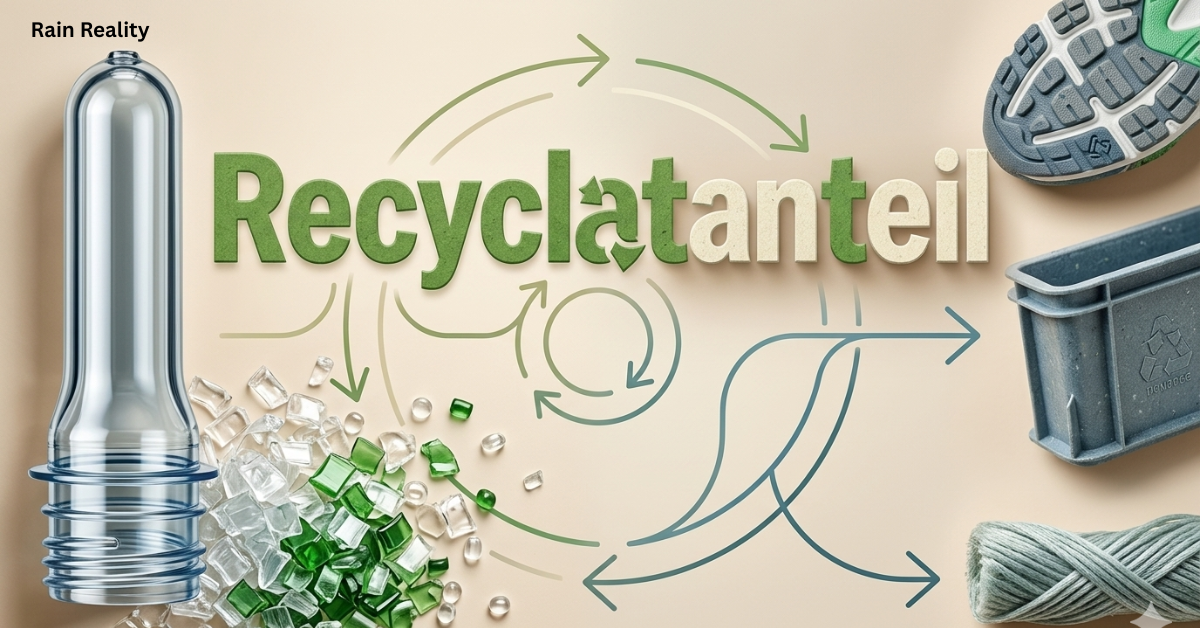
“Recyclatanteil” has become a popular phrase in today’s sustainability-conscious society. But is that all it means? Customers’ growing concern for the environment makes it all the more important that they grasp this idea. A product’s or package’s Recyclatanteil is the amount of recycled material that makes up the total. “Responsible production” is more than just a slogan; it has the power to alter our future.
Every day, we make choices that impact the planet. A circular economy that emphasises the reuse of materials rather than their disposal can be achieved by giving preference to items with a high Recyclatanteil. The significance of Recyclatanteil and its definition will be explored in this blog post. Come with us as we investigate its relevance to producers and buyers.
What is Recyclatanteil and Why is it Important?
The recycled content percentage, or recyclatanteil, is the amount of a product’s material composition that originates from recycled sources. This measure emphasises the proportion of a product that is composed of recycled materials instead than virgin resources.
Both makers and customers must have a thorough understanding of Recyclatanteil. By fostering resource efficiency and decreasing waste, it promotes sustainable practices. Products with a higher percentage of recyclatanteil use less energy during production.
Also, keeping tabs on recyclatanteil is a great way to boost sales of recycled products. High recyclatanteil can boost a company’s reputation among eco-conscious customers, who are more interested in their sustainability efforts.
One way to back circular economy efforts is to use more recycled materials. A more sustainable future, one in which resources are appreciated and maintained rather than thrown away after a single use, can be achieved by completing the material utilisation loop.
Impact of Recyclatanteil on the Environment
In terms of long-term ecological viability, It is crucial. Businesses can drastically cut down on the need for virgin resources by making use of recycled materials in their goods. This change helps to keep natural habitats intact and reduces the loss of resources.
Additionally, energy consumption during manufacture can be reduced with increased recyclatanteil. Making new materials from raw materials typically uses more energy than recycling. Greenhouse gas emissions are reduced as a result of this change.
Enhanced recycling rates also have a beneficial effect on waste management. When a product’s useful life has passed, it is usually much easier to recycle if it was made from recycled materials. This establishes a system of reusing and recycling materials, which leads to the development of a circular economy.
By highlighting the importance of a high recyclatanteil, we may inspire new ways of thinking about product design and get people to buy greener alternatives. This has far-reaching consequences that affect both industry norms and consumer expectations, not to mention specific products.
You May Like: Jipinfeiche: Meaning, Origin & Why It’s Trending
Factors Affecting Recyclatanteil Percentage
How much Recyclatanteil is in a product depends on a number of things. Choosing the right materials is crucial. One example is the difficulty of recycling sophisticated composites compared to plastics.
Significant roles are also played by manufacturing processes. More efficient use of recycled materials in production lines is a hallmark of environmentally conscious businesses.
Recycling rates can be boosted or lowered depending on the regulatory framework in place. The choices that businesses make when purchasing materials are influenced by policies that encourage recycling efforts.
Also, we can’t ignore consumer demand. Products with higher Recyclatanteil levels are more desirable among environmentally conscious buyers.
New product recyclate integration is greatly enhanced by technological improvements. The improved quality and accessibility of recycled materials for producers are guarantees of innovations in recycling procedures.
How to Calculate and Increase Recyclatanteil in Products
Finding the percentage of recycled content of your product is the first step in calculating its Recyclatanteil. To do this, it is necessary to dissect the production materials.
Using this data, you may calculate the percentage of recycled material by dividing the product’s overall weight by its recycled content weight. The percentage can be calculated by multiplying the figure by 100.
Innovative design and savvy sourcing are key to increasing Recyclatanteil. Find vendors that offer top-notch recycled products.
Think about cutting out extraneous parts and adding recyclable ones when you redesign packaging.
Another way to increase recycling rates is to institute a take-back program. Get people to send things back so they can be recycled or reused.
You may promote sustainability activities within your brand and increase the effectiveness of your efforts by collaborating with environmental organisations. Businesses can boost their Recyclatanteil and aid in environmental conservation by focusing on these strategies.
Examples of Companies Using High Recyclatanteil
A number of forward-thinking businesses are pioneering the use of high Recyclatanteil in consumer goods. As an example, Coca-Cola is worth mentioning. The use of virgin materials will be drastically reduced by 2030 as the corporation pledges to use PET plastic bottles with at least 50% recycled content.
Adidas is also at the forefront of this movement; the sneaker company uses recovered plastics from the ocean in numerous of its designs. One way that the fashion industry may help with environmental causes is through their Parley for the Oceans program.
With a high Recyclatanteil throughout all of their product categories, Unilever is also a leader in sustainability. By 2025, they hope to have increased their usage of recycled material and made all of their plastic packaging recyclable, reusable, or compostable.
These cases show how companies are starting to see the value in sustainable practices and the impact they can have on whole industries.
Conclusion
When it comes to developing environmentally friendly procedures in business, the idea of Recyclatanteil is crucial. Businesses and consumers alike might be motivated to make greener decisions when they grasp its meaning and importance.
The environmental impact of Recyclatanteil is significant, as we have shown. We help reduce waste and conserve resources by giving preference to products with greater recyclability percentages. Materials quality, manufacturing methods, and customer demand are some of the major factors that impact these percentages.
Companies that want to improve their sustainability profiles must calculate and increase the Recyclatanteil in their products. A lot of companies have already realised this and are working on ways to make their products more recyclable so that they can attract more environmentally concerned customers.
There is optimism for a more environmentally friendly future as more and more companies pledge to use high amounts of Recyclatanteil. Our shared endeavour to comprehend and use this principle will bring us nearer to accomplishing all-encompassing environmental objectives that are advantageous for all living beings on Earth.
Read More: ASX1 Com: Meaning, Uses & What It Is